Teaching the 5 Pillars of Islam to Children: A Parent's Playbook

Before a child reads a single ayah, before they learn a single Arabic letter, they need something deeper: a reason to love the Quran at all. That reason starts with understanding who they are — a Muslim — and what being a Muslim actually means. And that understanding begins with the Five Pillars of Islam.
For Muslim parents teaching Islam and Quran to kids, the Five Pillars are the skeleton on which everything else hangs. Taught well, they give children a clear, simple framework for their whole religious life. Taught poorly — as a list of rules to memorize — they become trivia.
This post is a practical playbook for teaching the Five Pillars to children ages 4–12, with age-appropriate angles, family rituals, and the specific stories we use in Miyao’s Discover Islam land.
Start with “why Islam,” not “what Islam”
The biggest mistake adults make when teaching the Pillars is jumping straight into definitions. “Salah means prayer, which Muslims do five times a day.” That’s correct — and forgettable.
Children learn belief the same way they learn language: through patterns, stories, and emotion. Start with the why of Islam before the what. Ask:
- “What do you think makes someone a good friend?”
- “If you had one rule for the whole world, what would it be?”
- “Why do you think we say thank you for food?”
Then connect: “Islam is the way Allah taught us to live — like a guide for how to be a good friend, a good person, and how to say thank you to Him.” Only after this conversation do the Pillars land with meaning. They become the how of a life you’ve already helped them want.
The 5 Pillars, in kid-friendly terms
Here’s how we explain each pillar to a 7-year-old. Adjust the language up or down based on your child’s age — but notice how each one starts with a feeling before a definition.
1. Shahada — “Saying what you believe”
“The first pillar is that we say out loud what we believe: there is no God but Allah, and Muhammad ﷺ is His messenger. It’s like our heart’s name tag. We say it when we’re born, when we pray, and when we want to remember who we are.”
Kid activity: Ask your child to imagine they’re being asked, “what do you believe?” Practice saying the Shahada in Arabic and in your language together. The simplicity — one sentence — is the point.
2. Salah — “Five times a day, we remember Allah”
“Salah is our prayer. Five times every day, no matter what we’re doing, we stop and talk to Allah. It’s like a phone call we get to make with the One who made us.”
Kid activity: Show them your prayer times on the Azan app. Let them press the button to turn off the azan. If they’re too young to pray full prayers, let them do just the sujood (prostration) with you — three seconds is enough. Children who grow up seeing a parent pray grow up praying.
3. Zakat — “Sharing what you have”
“Zakat means that every year, if Allah has given us more than we need, we give some of it to people who don’t have enough. It’s not charity — it’s a rule. Because Allah says what we have isn’t really only ours.”
Kid activity: Give your child a small bag of coins and ask them to pick how much to put in a “Zakat jar.” Even a few coins matter. The lesson is not the amount — it’s the reflex.
4. Sawm — “Fasting in Ramadan”
“In Ramadan, grown-up Muslims don’t eat or drink from sunrise to sunset. We do it to feel what people who don’t have food feel. We do it to remember that the food we usually have is a gift, not a given. And we do it to remind our bodies that they can wait — because our hearts are stronger than our hunger.”
Kid activity: Before age 9, most kids don’t fast. But they can do a “mini-fast” of a few hours, or skip just breakfast, or give up a favorite treat during the day. Let them feel a tiny taste of it, then celebrate iftar with them.
5. Hajj — “The journey every Muslim dreams of”
“At least once in their life, if they can, every Muslim travels to Mecca — the city where the Ka’bah is. Millions of people, from every country, all wearing the same simple white clothes, all walking the same circle around the same small building. Rich and poor, king and farmer — all together, all equal.”
Kid activity: Watch a short, respectful video of the tawaf around the Ka’bah. Ask your child what they notice. The image of a human river circling one point stays with them forever.
The sequence that works
When teaching the Five Pillars, sequence matters. We teach them in this order (not strictly the “formal” order) because it mirrors the child’s life:
- Shahada — what you believe (identity)
- Salah — daily rhythm
- Sawm — yearly rhythm
- Zakat — the habit of sharing
- Hajj — the big, one-day-maybe dream
This sequence moves from every second (belief) to every day (prayer) to every year (Ramadan) to a lifetime ambition (Hajj). It matches how children actually absorb concepts — most frequent first, most abstract last.
Use stories, always
The single most effective tool for teaching the Pillars — and everything in Islam — to children is stories. The life of Muhammad ﷺ is full of small moments that illustrate each Pillar perfectly:
- For Shahada — the moment Bilal, under torture, said Ahad (“One”) while being crushed by a stone. One word. One belief.
- For Salah — the Mi’raj, where Allah first gifted the Muslims the five daily prayers.
- For Zakat — the Prophet ﷺ giving away everything he had, to the point that his family sometimes had nothing for dinner, and never regretting it.
- For Sawm — the first Ramadan, and the revelation of the Quran itself in that very month.
- For Hajj — the tawaf of Ibrahim and Ismail (peace be upon them), the story of Hajar running between Safa and Marwa.
A child who grows up with these stories doesn’t need to memorize the Pillars. They live inside them. For more on why stories are so powerful, see our 10 fun ways to teach the Quran to kids guide.
Age-specific tips
Ages 4–6: Focus entirely on Shahada and Salah. Let them say the Shahada daily. Let them join your prayers, even if all they do is sit beside you. Don’t worry about the other three pillars yet.
Ages 7–9: Introduce Sawm and Zakat. Let them practice short fasts. Let them give Zakat from their own money. This is the perfect window for the emotional weight of these pillars to land.
Ages 10–12: Full comprehension of all five. By this age, children can understand the why behind each pillar, not just the what. Have real conversations. Ask them what they think. Let them wonder.
Family rituals that teach without “teaching”
The most effective Pillar-teaching doesn’t happen in lessons. It happens in the rhythm of the home:
- Praying together (even once a day counts)
- Making Ramadan feel like the most magical month of the year
- Giving charity as a family every week, not just yearly
- Saying Bismillah at every meal
- Ending the day with the Shahada
- Visiting Muslim-majority countries or attending Hajj/Umrah if possible
Children don’t remember what you taught them about the pillars. They remember what you did.
Where apps fit in
A good Quran app for kids — like Miyao — covers the five pillars as dedicated lessons early in the curriculum, paired with prophet stories, daily duas, and the foundational concepts of Iman. The goal isn’t to replace family teaching. It’s to give children a second, consistent source of warm, accurate Islamic learning that shows up every day even when you’re too tired to teach.
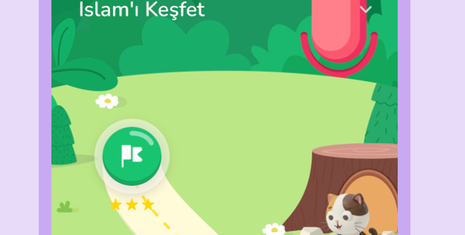
Our Land 1, Discover Islam, includes 17 lessons covering all five pillars with stories, visuals, and mastery-based quizzes. Our mastery method post explains why this works better than traditional memorization.
The one thing that matters most
If your child grows up understanding just one thing deeply about each of the Five Pillars, they’ll carry Islam for the rest of their life. Depth beats breadth. A child who really understands why we pray five times a day — not just that we do — will pray willingly as a teenager. A child who really feels Zakat in their heart will grow into an adult who gives joyfully.
Teach the Pillars slowly. Teach them with stories. Teach them through what they see you do. And trust that the seeds you plant will grow — sometimes quietly, sometimes for years — before they bloom into the Muslim your child will become insha’Allah.
For the full picture of how the Pillars fit into a child’s Quran journey, read our complete Quran for kids parent guide, and try the free lessons in Miyao’s Discover Islam land to see how it all comes together.