Quran for Kids: A Complete Guide for Muslim Parents (2026)

Teaching the Quran to kids is one of the most meaningful responsibilities a Muslim parent carries. It’s also, honestly, one of the hardest to get right. You want your child to love the Quran — not just recite it. You want them to understand it, not just memorize it. And somewhere between busy school days, screens, and short attention spans, you want the experience to feel joyful instead of forced.
This guide pulls together everything we’ve learned working on Miyao — a Quran app for kids ages 7–12 — about what actually helps children fall in love with their deen. It’s structured around the questions Muslim parents ask most: when to start, what to teach first, how to keep kids engaged, and where modern tools fit in.
Why “Quran for kids” needs its own approach
Adults and children learn the Quran in fundamentally different ways. An adult can sit with a mushaf for an hour, decode tajweed rules, and push through difficulty with willpower. A seven-year-old can’t — and shouldn’t have to.
Children need three things adults don’t:
- Short sessions. A child’s deep-focus window is usually 8–15 minutes. Anything longer and retention drops sharply.
- Mastery, not completion. A kid who “finishes” a page without understanding it gets nothing. A kid who masters one letter carries it for life.
- Emotional warmth. Children learn best when they associate the Quran with love, not pressure. The tone of the teacher shapes the relationship for decades.
When people ask “what’s the best way to teach Quran for kids,” they’re almost always really asking: how do I do this without turning my child off of it? That’s the right question.
The four stages of Quran learning for kids
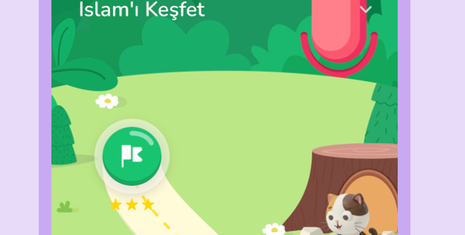
Most successful Quran-for-kids curricula follow a predictable arc. At Miyao we use 8 Lands, but almost every thoughtful approach — from traditional maktabs to modern apps — moves through these four stages:
Stage 1 — Faith and stories (ages 5–7)
Before any reading begins, children build the reason to love the Quran. They learn:
- Who Allah is
- The 5 Pillars and 6 Pillars of Iman
- Stories of the prophets (peace be upon them)
- The life of Muhammad ﷺ
- Daily duas, basic adab, Ramadan and Eid
This stage is oral, visual, and narrative. No Arabic decoding yet. The goal is that when a child later sees an Arabic letter, they already have a relationship with the Book it builds.
Stage 2 — The Arabic alphabet (ages 6–8)
Now the mechanics begin. Children learn all 28 Arabic letters — their shapes, sounds, and how to trace them. This is a huge leap for kids used to English letters. Tracing on paper (or a tablet) is essential; the muscle memory of forming each letter is as important as recognizing it.
Our own Arabic letters for kids guide goes deeper on how this stage works.
Stage 3 — Vowels, joining, and first words (ages 7–9)
Letters alone don’t make words. Children learn harakat (fatha, kasra, damma), then how letters join and change shape, then how to sound out their first real syllables and words. This is the “early reading” equivalent for Arabic — and for most children, it’s where consistency matters most. Ten minutes a day beats an hour once a week.
Stage 4 — Short surahs (ages 8–12)
Finally, the reward: actually reading and memorizing Quran. Children typically start with the short surahs of Juz ‘Amma — Al-Fatiha, Al-Ikhlas, Al-Falaq, An-Nas, Al-Kawthar, and so on. See our short surahs guide for the full recommended list.
The four mistakes that make kids dislike the Quran
Over and over, we see the same patterns sabotage well-meaning parents:
- Starting too early with decoding. Forcing a 4-year-old to identify letters before they understand why is a direct path to resistance.
- Treating the Quran like homework. If every session feels like school, the child’s brain files it next to multiplication tables.
- Shaming mistakes. A child who fears getting it wrong will avoid trying. Mistakes are the raw material of learning.
- Inconsistency. Three hours on Saturday, nothing all week. Children’s brains need daily short exposures, not weekly long ones.
The good news: fixing these four things alone, even without any app or curriculum, transforms how children relate to the Quran.
What a good day of Quran learning looks like
For a child ages 7–12, a healthy rhythm usually looks like this:
- 5–10 minutes after school — review yesterday’s material. No new content. Just warm repetition.
- 10–15 minutes in the evening — one small new step. A new letter, a new vowel, one ayah added to what they’re memorizing.
- 1–2 minutes before bed — recite one surah together. Not as a test. As a lullaby.
That’s 20 minutes a day, maximum. Over a year, it becomes mastery. Over five years, it becomes identity.
How apps fit into Quran for kids
Ten years ago, most parents had two options: the local mosque or a private tutor. Today, Quran apps for kids are a third — and for many families, the most practical one. Here’s how to evaluate them:
Good Quran apps share a few things:
- Offline-first (no dependency on Wi-Fi)
- No ads, ever
- Progressive disclosure (no quizzing on what hasn’t been taught)
- Real audio by qualified reciters
- Tracing, not just tapping, for Arabic letters
- Celebration of effort, not just correctness
Red flags in Quran apps:
- Excessive gamification that rewards speed over understanding
- Third-party tracking or social features
- In-app purchases pushed at kids
- Translations that feel preachy instead of warm
At Miyao, we built the app we wish existed when our own kids were this age. You can read about the mastery method that drives its lesson system — it’s the single biggest reason kids stick with it.
Should I use an app, a tutor, or both?
The honest answer: both, when possible. Apps are exceptional for daily consistency — they show up, they don’t get tired, and they never lose patience. Tutors are exceptional for nuance — pronunciation correction, personal encouragement, and the irreplaceable human touch.
For most families, the winning combination is:
- 20 minutes a day on an app for consistency, habit-building, and progress
- 30 minutes a week with a teacher (online or in-person) for correction and warmth
If a tutor isn’t accessible, a good app alone still gets a child 80% of the way there. And many children learn faster with an app than they ever did in a classroom — because mastery learning respects their pace.
When will my child be “done”?
Spoiler: never. And that’s the point.
The Quran isn’t a subject to graduate from. Children who reach the end of our eight-land curriculum at around age 11–12 aren’t finished — they’re started. They can read. They know the foundational stories. They have 10 short surahs in their heart. From there, the path widens — into deeper tafsir, more memorization, and the lifelong companionship with the Book that is the real goal.
If your child gets to that point loving the Quran, you’ve done the hardest part.
The next step for your family
If you’re just beginning to think about Quran for kids as part of your family’s daily rhythm, start small. One surah. Five minutes. Today.
If you’re ready for a structured path, try the free lands on Miyao. The curriculum is built by people who’ve spent years obsessing over this exact question, and the app is designed so that your child asks to open it.
And if you want to go deeper, our next post covers the best age to start teaching Quran to kids — with research, real parent stories, and what to do if you feel like you’re starting “late.”
Whatever path you choose, remember: the goal isn’t a child who can recite perfectly. It’s a child who, twenty years from now, still reaches for the Quran when life gets hard. That child is built one quiet, joyful session at a time.