10 Short Surahs Every Muslim Child Should Memorize (And How to Teach Them)

There’s a moment in every Muslim child’s life that their parents never forget: the first time they hear their child recite a surah out loud, correctly, without help. It’s a shiver. The language of the Quran, coming from the lips of their own child, stored now in their own heart.
For most families, that moment happens with a short surah. Not a long one. Not a complicated one. A short, beautiful, memorable one from Juz ‘Amma — the final section of the Quran, which is where Quran memorization for kids almost always begins.
This guide walks through the 10 short surahs we recommend teaching first, why these specific ones, the order that works best, and exactly how to help your child memorize each without turning it into a struggle.
Why start with Juz ‘Amma?
Juz ‘Amma — the 30th and final juz of the Quran — contains most of the short, rhythmic surahs that were revealed early in the Prophet ﷺ’s mission in Makkah. They’re short on purpose: they were meant to be memorized and passed along quickly by a mostly oral society.
Fourteen hundred years later, they’re still the perfect on-ramp for a child’s heart. They’re:
- Short — most are under 10 ayahs, some are just 3–5
- Rhythmic — they rhyme, which makes them stick
- Repetitive in structure — patterns help memory
- Powerful in meaning — real themes, not filler
- Frequently recited in prayer — your child will actually use them
Every Muslim child who grows up to pray will be reciting these surahs daily for the rest of their life. So the goal isn’t just memorization — it’s durable memorization. The ones you learn young, you never forget.
The 10 short surahs to start with
Here are the ten we recommend, in a learning-friendly order. For each, we include its ayah count, a one-line theme, and an age-appropriate hook that helps kids understand what they’re memorizing.
1. Al-Fatiha (7 ayahs) — “The Opening”
The surah every Muslim recites in every unit of prayer. This is always the first to memorize, no matter your child’s age, because without it they can’t pray.
Kid hook: “This is the one Allah told us to say every single time we talk to Him. It’s the opening of every conversation.”
2. An-Nas (6 ayahs) — “The People”
Asking Allah to protect us from whispers — the bad thoughts that sneak into our heart.
Kid hook: “When a bad thought tries to sneak in — like being mean to your brother — this is the surah that helps us ask Allah to close the door.”
3. Al-Falaq (5 ayahs) — “The Daybreak”
Asking Allah to protect us from harm that comes from outside — the darkness of the night, envy, bad magic.
Kid hook: “When something scary happens — a storm, a bad dream, something that makes you worried — this surah is like a shield.”
4. Al-Ikhlas (4 ayahs) — “The Sincerity”
The ultimate description of Allah: One, eternal, not born, not giving birth, nothing like Him.
Kid hook: “People used to ask: what is Allah like? What does He look like? Allah answered with four lines that fit on one hand.”
5. Al-Kawthar (3 ayahs) — “The Abundance”
The shortest surah in the Quran. Allah gave the Prophet ﷺ abundance — so pray and sacrifice, and don’t worry about the haters.
Kid hook: “This is the tiniest surah in the whole Quran. Just three lines. But it tells us something big: when people are mean, what do we do? We pray and we keep going.”
6. Al-Fil (5 ayahs) — “The Elephant”
The incredible story of Abraha’s army attacking Makkah with elephants — and tiny birds, carrying tiny stones, destroying them all.
Kid hook: “Imagine: a huge army, riding elephants, coming to destroy the Ka’bah. Allah sent thousands of tiny birds, and the army was gone. Tiny beats huge, when Allah decides.”
7. Al-Asr (3 ayahs) — “The Time”
The second shortest surah. Time passes. People lose. Except those who believe, do good, and remind each other of the truth.
Kid hook: “This surah is like a life rulebook. Three lines. Learn them, and you know how to live a life that matters.”
8. Quraysh (4 ayahs) — “Quraysh”
Thanking Allah for the safety and sustenance He gave the tribe of Quraysh in Makkah.
Kid hook: “The Prophet ﷺ’s tribe. Allah gave them trade, food, and safety — and this surah reminds them to thank Him.”
9. An-Nasr (3 ayahs) — “The Help”
When Allah’s help comes and people enter Islam in crowds — praise Him and ask forgiveness.
Kid hook: “This surah was revealed near the very end of the Prophet ﷺ’s life. When a huge blessing happens, what do we do? We thank Allah and we ask forgiveness. Never pride.”
10. Al-Masad (5 ayahs) — “The Palm Fiber”
A warning about those who hurt the Prophet ﷺ — especially his uncle Abu Lahab and his wife.
Kid hook: “Even the Prophet ﷺ had an uncle who was mean to him. This surah shows that being family doesn’t automatically mean being good — what matters is how we treat people.”
The order that makes memorization easier
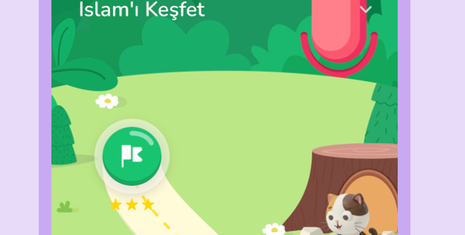
Parents often ask: “What order should I teach these in?” The answer we’ve settled on in Miyao’s Garden of Surahs is:
- Al-Fatiha first — essential for prayer
- An-Nas, Al-Falaq, Al-Ikhlas — the “three protective” surahs, grouped together
- Al-Kawthar, Al-Asr — the two shortest surahs, quick confidence wins
- Al-Fil, Quraysh — the Makkan story pair
- An-Nasr, Al-Masad — rounding out the set
This sequence moves roughly from essential → short → story-based → late-revelation. It also alternates theme and length, which keeps kids engaged. Teaching all the “protective” surahs back-to-back, or all the “story” ones back-to-back, creates fatigue.
How to actually memorize a surah with a child
The “right way” isn’t what most parents were taught. Here’s what works:
1. Listen before reading
Before you show your child the Arabic text, let them hear the surah 5–10 times across a few days. Children’s ears absorb rhythm and sound long before their eyes track letters. By the time they start working on the text, their brain already knows the melody.
2. Break it into small chunks
A 5-ayah surah should not be memorized as one unit. Break it into:
- Ayah 1 — master
- Ayah 1 + 2 — master
- Ayah 1 + 2 + 3 — master
- …
Each new ayah is added only after the previous set is solid. This is the mastery method, and our dedicated mastery method post explains why it works so much better than whole-surah memorization.
3. Use repetition disguised as play
Recite together on the walk to school. Recite in the car. Recite while brushing teeth. Recite as a whisper, then a shout, then a whisper again. Repetition builds memory, but only if it doesn’t feel like drilling.
4. Celebrate small wins
Every new ayah is a milestone. A high-five. A smile. Never just “okay, next.” Children’s memory is tied to emotion — and the emotion of being celebrated locks the ayah in place.
5. Review, review, review
A surah “memorized” once is not memorized for life. A surah recited daily for three weeks becomes part of your child. Build review into every day — even after they’ve “finished” memorizing.
How long should this take?
A motivated child at 10 minutes a day will typically memorize all ten surahs in 4–8 months. Some will be faster, some slower. Speed isn’t the goal. Durability is.
If you’re using a Quran app for kids that supports spaced review (like Miyao’s Garden of Surahs), the system handles the repetition scheduling for you — showing old surahs just before they’re likely to fade.
What comes after these ten?
Once your child has solid memorization of the above, they’re ready for:
- The remaining short surahs of Juz ‘Amma
- Longer surahs like Ya-Sin or Al-Mulk (often recited nightly)
- Deeper memorization goals if your family chooses the hifz path
For the broader picture of where memorization fits in a child’s full Quran journey, see our complete Quran for kids guide and our post on the best age to start teaching Quran.
The quiet gift
Every parent who has memorized surahs alongside their child will tell you the same thing: they didn’t just teach their child. They relearned these surahs themselves. Slowly, deeply, with meaning they didn’t have the first time around.
The Quran works this way. It gives back, multiplied, to whoever touches it with sincerity — child or adult.
If you want a structured path that takes your child through these ten surahs step by step, with audio, repetition, and mastery built in, Miyao’s Garden of Surahs is designed for exactly that. Ten surahs, ten lessons, a lifetime of recitation.
Start with Al-Fatiha this week. One ayah a day. You’ll be surprised how fast your child starts reciting along with you — and even more surprised at the way it changes your home.